
The Grinder Doing Its Work
Twenty-two seconds of diamond grinding around a center drain and along the cracks, with the vacuum pulling the dust before it settles on anything.

TOUGH SLABS FOR WORKING SHOPS. Our Utica crew coats pole barns, workshops, and commercial bays across Central NY—typically $7 to $17 per sq ft. We diamond-grind your slab, mend joints and spalls, and apply 100% solid epoxy and polyaspartic armor for floor jacks and oil.


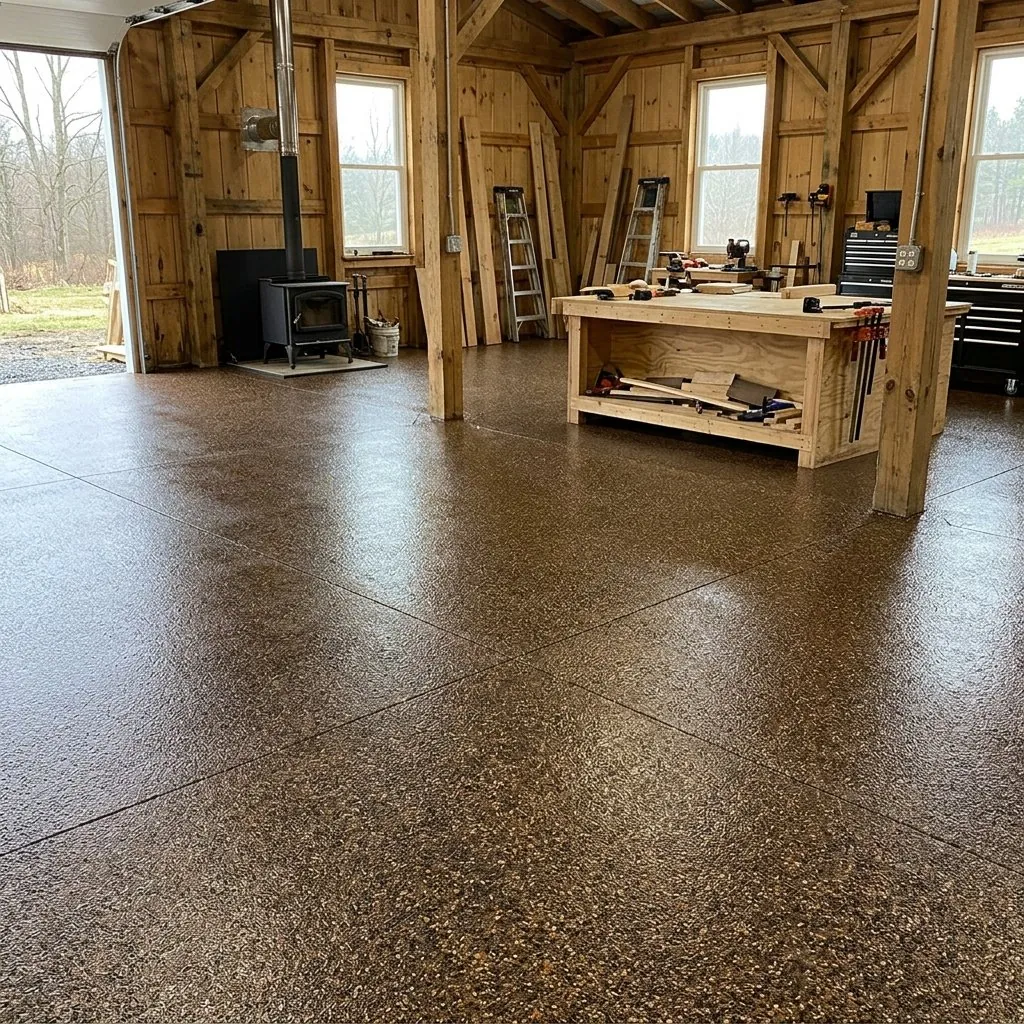

A barn or shop floor has a harder life than any garage: tractor tires, floor jacks, dropped sockets, hydraulic fluid, and a slab that was poured wide and left bare. We grind it, fill the joints and spalls, and coat it with the same 100% solid epoxy and polyaspartic system, laid down heavier. Three of ours below, from a timber pole barn to a commercial bay.
Espresso, amber and river-rock flake broadcast to full coverage in a working woodshop barn, finished with a low-glare satin topcoat that hides sawdust.
High-build solid epoxy for forklift and pallet-jack traffic, expansion joints filled flush, finished with safety-yellow aisle striping.

Charcoal and slate flake broadcast flush into the floor drains. Built for rolling tool chests, dropped wrenches and weekend oil changes.
Same four steps as every floor we install, with more grinding, more joint work and a heavier build. Big floors are done in sections so the shop keeps running.
Walk-behind diamond grinders take off the troweled glaze, old paint, sealer and years of oil so the pores are open. The vacuum catches the dust at the head, so tools and parts stay clean.
Control joints are filled flush with a flexible joint filler so wheels roll over them. Cracks are chased and filled, and spalled edges at doors and drains are ground back to sound concrete and patched.
Barn slabs sit on gravel and ground that stays wet, so every one is metered first. A thick 100% solid epoxy basecoat seals the concrete, with a moisture-blocking primer first when the reading calls for it.
Full flake or a high-build solid color goes over the basecoat, with safety striping or a slip-resistant grit where you want it. A polyaspartic clearcoat locks it all in against fluids and hot tires.
Twenty-two seconds of diamond grinding around a center drain and along the cracks, with the vacuum pulling the dust before it settles on anything.

Four hours later on the same slab: the routed cracks are filled flush and the moisture-blocking basecoat has sealed the concrete. The flake or solid color goes on top of this.
Darker flake blends like Cabin Fever, Blacktop, Armadillo and Slate hide sawdust, mud and oil drips between sweepings, roughly 18 pounds of chips per 100 square feet so no bare basecoat shows through. Shops that want a plain floor get a high-build solid gray with safety-yellow striping instead. Browse the blends below, and we bring real sample chips to your shop so you can see them on your own floor.


Every residential and commercial floor installed by our local crew includes a 1-year craftsmanship warranty covering installation and workmanship. Commercial coating materials are backed by the manufacturer's product warranty against bond failure, peeling, and delamination.
Direct mechanical diamond preparation, crack restoration, and moisture-tested application completed by our in-house Central New York installation crew with zero outsourced subcontractors.
100% solid commercial epoxy basecoats and UV-stable polyaspartic clearcoats backed by the manufacturer's product warranty against bond failure, peeling, and hot-tire delamination.
Pick the building, how the concrete looks today, and your rough shop size. Our local crew will reach out within 2 hours to talk it through, review photos, or walk your shop slab with you in person.
Most of the shop floor epoxy we install goes into one of four buildings. Each one gets the same prep and a finish picked for what rolls across it.
A fresh pour in a 30-by-40 or 40-by-60 barn, bare and dusting. We let it cure, meter it, grind the troweled glaze off and coat it before the first tractor leaves a stain.
Snowmobiles, side-by-sides, boats and the trailer that hauls them. Flake hides the mud and road salt they drag in, and the clearcoat takes the trailer jack.
Floor jacks, jack stands, creepers, hot fluids and welding slag. A high-build floor done one bay at a time so you keep working, with striping where you want it.
Pallet jacks, forklifts and rolling carts over control joints. Joints filled flush, solid color or flake, and a sweep-clean surface that stops the concrete dust that gets into everything.
A heavy duty workshop floor coating has to take point loads, not just foot traffic. A floor jack puts the weight of a truck on four small steel wheels; a dropped socket set lands on one edge. Our basecoat is 100% solid epoxy laid thick into ground-open concrete, which is what keeps the floor from chipping under either.
The polyaspartic clearcoat is the chemical layer. Motor oil, hydraulic fluid, gear oil, coolant and brake cleaner sit on top of it and wipe up instead of soaking into the slab. Flake adds a light texture for grip under wet boots, and for a wash bay or a sloped ramp we broadcast a slip-resistant grit into the clearcoat.
Fresh concrete is full of water, and a pole barn concrete floor coating put down too soon traps it. We wait about a month after the pour, then meter the slab before scheduling. A new barn slab that reads high gets the moisture-blocking primer under the basecoat; one that reads dry goes straight to grinding.
The best time to coat a new barn is before anything moves in. No oil stains to chase, no equipment to shuffle, and the whole floor can be done in one visit or two. If the barn is already full, we coat it in halves and move the equipment once.
About a month of cure, a moisture reading, then grinding off the troweled glaze and any curing compound the finisher sprayed on. Control joints get filled flush at the same time.
Oil-soaked spots are degreased and ground deeper, spalled door thresholds and drain edges are rebuilt, and old paint or sealer comes off down to bare concrete before the first coat.
Most barn floor coatings sold by the pail are either a thin paint or a penetrating sealer. Both go on in an afternoon and both are gone from the tire paths within a season or two, because neither one has any thickness to wear through and neither is bonded into the concrete.
A pole barn floor coating from our crew is many times thicker, bonded into ground-open pores, and finished with a clearcoat that was built for fluids and tires. It is a floor, not a film. When a painted or sealed barn comes to us, the old product has to be ground off first, which is why we would rather coat a bare slab.
Sits on top of the slab. Lifts under a hot tire, scuffs through under a jack wheel, and lets oil soak in wherever it has worn. Has to be ground off before a real coating can go down.
Slows dusting for a while but leaves the concrete porous and the surface as rough as it was poured. Wears out of the traffic lanes and needs redoing. Fine for a hay barn, not for a shop.
Slow-soaking 100% solids epoxy grips ground concrete, and our UV-stable polyaspartic topcoat handles winter road salt and hot highway tires. Polyurea stays strictly in routed cracks.
"One-day" franchises roll fast-setting polyurea onto bare slabs instead. See what a 15-minute cure versus a 45-minute soak leaves inside concrete pores in our side-by-side breakdown.
Straight answers to what barn and shop owners across Central and Northern New York ask before they book a floor.
From our Utica home base, our crew coats pole barn, workshop, and commercial shop floors across Central New York. Pick your area to start an estimate with your town already filled in.
Auto shops, fabrication floors, and workshop garages across Utica, Rome, New Hartford, Whitesboro, Clinton, and Oneida County.
Get a Utica Shop EstimatePole barns, toy hauler bays, and commercial slabs across Carthage, Clayton, and the Fort Drum area.
Get a Watertown Barn EstimateEquipment bays, workshops, and warehouses across Fulton, Pulaski, and nearby lakeshore towns, including the striped bay above.
Get an Oswego Shop EstimateBarn and shop floors through Ilion, Frankfort, Little Falls, and up into Old Forge, where the grinding video on this page was shot.
Get a Herkimer Shop EstimatePole barns and equipment barns across Croghan, Lyons Falls, and surrounding towns, including the timber barn at the top of this page.
Get a Lowville Barn EstimateAnswer a few questions below and your request goes straight to our Utica crew—no call centers or lead brokers. We reach out within 2 hours to share a written price range, look over photos, or schedule an on-site visit with real flake samples.