
Epoxy vs. Polyurea vs. Polyaspartic: What Is Actually Going on Your Concrete Floor.
Epoxy, polyurea and polyaspartic are all resin coatings that go over concrete, but they bond and build thickness very differently. Our crew installs a thick 100% solids epoxy base for the slab bond and a UV-stable polyaspartic topcoat for sun, salt and chemical protection. Here is what each coating actually does and why we put them in that order.
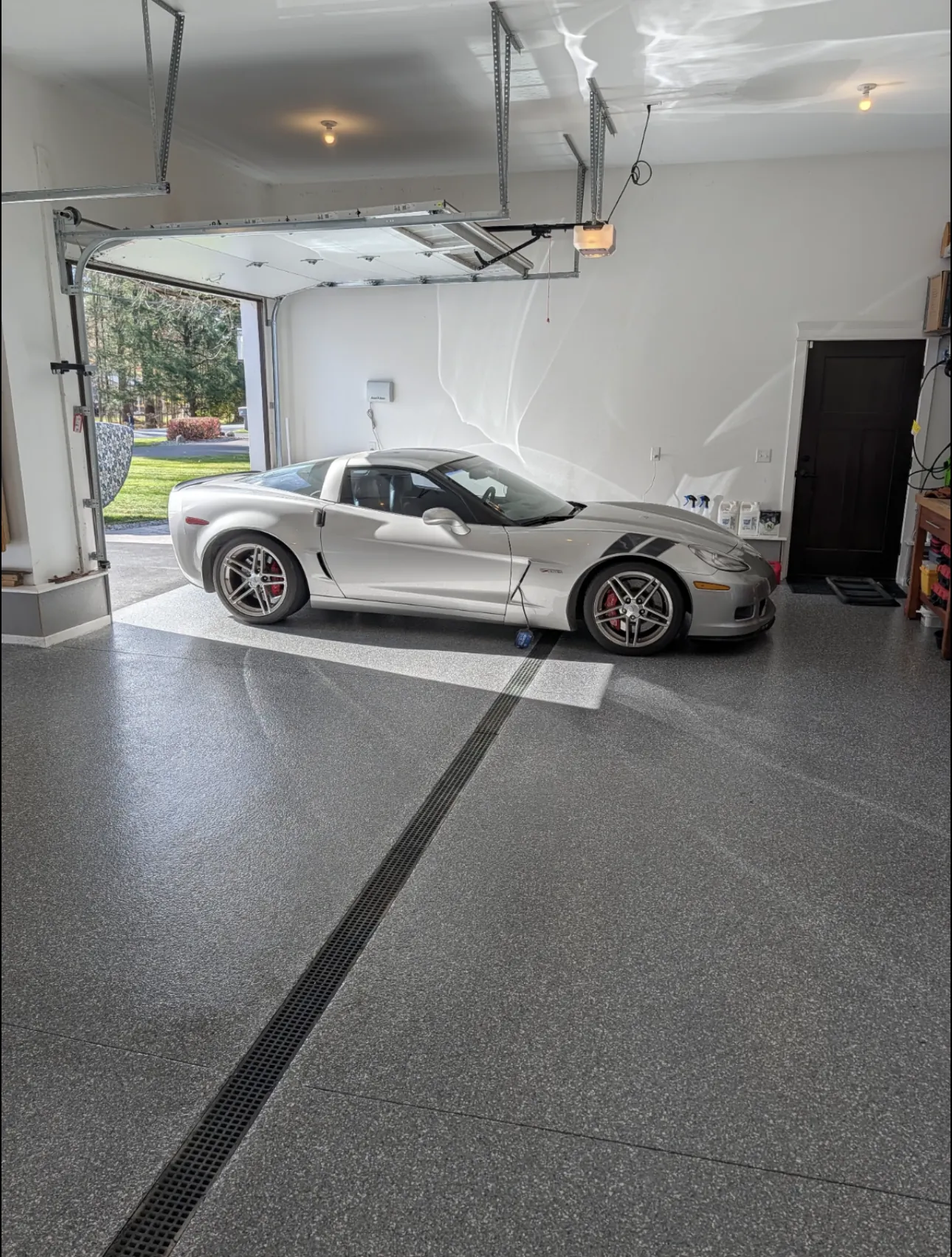

What is epoxy, really?
Epoxy is a two-part resin that cures slowly into a thick, rigid coating once the resin and hardener are mixed. The commercial material our crew pours is 100% solids, which means no water or solvents evaporate out of it as it sets. When we squeegee and back-roll it onto a slab at 10 to 20 mils thick, that full thickness stays on your floor.
That slow, high-build cure matters for three reasons. First, it gives our installers a long working window to push wet resin deep into the open pores of freshly diamond-ground concrete. Second, the film thickness bridges hairline craze cracks and minor trowel marks instead of showing every flaw in the slab. Third, a thick epoxy bed holds a full vinyl flake broadcast, roughly 18 pounds of color chips for every 100 square feet, without letting the chips sink flat or blow loose.
Left exposed to direct sun, standard epoxy can amber over time, which is why we do not leave it as the top layer. And a hardware-store "garage floor paint" or water-based roll-on kit is not the same material at all: those DIY coatings are mostly water, dry down to 2 or 3 mils, and are the peeling floors most homeowners picture when they hear a neighbor say their epoxy failed.


What is polyurea, and what are its disadvantages?
Polyurea is a fast-reacting two-part resin in the urethane family, originally made for spray-on truck bedliners, bridge decks, and industrial tank linings. Franchise floor marketers adopted hand-rolled polyurea basecoats because the resin gels in minutes. A crew can coat a garage and pack up the trailer in a single afternoon.
On a bare residential concrete slab, that speed comes with real trade-offs every homeowner should understand before paying for a polyurea basecoat:
-
Extremely fast cure time Polyurea can gel on the surface before it soaks into the concrete pores, which can lead to a weaker mechanical bond and a greater chance of install imperfections showing through.
-
Reactive to UV and moisture Polyurea is reactive toward UV radiation and slab moisture during cure, so it can shift color or lose its bond if the concrete is not dry and properly prepared first.
-
Goes on extremely thin Hand-applied polyurea has a watery consistency that builds far less film thickness than 100% solids epoxy and is not the best consistency to broadcast flake into.
When a floor genuinely calls for a faster cure window, modified polyaspartic is the material we recommend rather than raw polyurea.
What is polyaspartic?
Polyaspartic is a type of polyurea that has been modified to overcome the challenges standard polyureas face. Because its reaction rate is controlled, polyaspartic has a longer pot life, which makes it easier for installers to roll out evenly and helps improve adhesion.
Just as important, polyaspartic is UV-stable in direct sunlight, shrugs off gasoline, motor oil and household cleaners, and cures into an abrasion-resistant clear armor. Where polyaspartic falls short is film build on rough bare concrete: like other urethanes, it goes down thin, which makes it an outstanding clear topcoat over broadcast flake rather than a standalone high-build basecoat on a pitted slab. That is why we use polyaspartic as the clearcoat over every garage and exterior floor we install.
How do epoxy, polyurea and polyaspartic compare?
The short version: 100% solids epoxy is the thick, slow-setting layer that anchors into ground concrete, polyurea is the thin, fast-gelling one, and polyaspartic is a modified polyurea built to stay clear and tough in sunlight. Here is how all three line up on the things that decide whether a concrete floor lasts.
| Property | 100% solids epoxy | Polyurea | Polyaspartic |
|---|---|---|---|
| What it is | Two-part high-build resin that slowly hardens into a thick, rigid structural coat (10 to 20 mils) | Fast-reacting two-part resin in the urethane family | Modified polyurea with a controlled working window |
| Working time after mixing | 30 to 45 minutes to wet deep into the open pores of ground concrete | Very short (often 5 to 15 minutes); can set before soaking into dense slabs | Extended working time for clean, even roller and squeegee coverage |
| Thickness per coat | Thick high-build layer that hides minor slab flaws and patched cracks | Thin and watery (~3 to 6 mils) | Medium-thin (~4 to 8 mils), built to lock down as a clear protective topcoat |
| How it handles flake | Holds a full wall-to-wall broadcast (~18 lb per 100 sq ft) | Not the best consistency to broadcast heavy flake into | Seals the scraped flake bed under a hard, wipe-clean topcoat |
| Sunlight | Can amber in direct sun, so we do not leave it exposed on top | Reactive to UV; can shift color | UV-stable clarity that resists sunlight yellowing |
| Where our crew uses it | Primary slab-bonding basecoat and full-flake receiver | Crack and control-joint filler only, not as a floor coat | Protective clearcoat on garages, shops, steps and exterior concrete |
What does our crew install, and why?
We build every floor in layers because the order of the chemistry is what makes a coating hold onto concrete. First, our crew runs heavy walk-behind diamond grinders with dust extractors across the slab to open clean concrete pores. Next, we meter the concrete for trapped dampness and roll on a deep moisture-blocking primer whenever the reading calls for it. Over that prepared slab, we pour a thick 100% solids epoxy basecoat with a full vinyl flake broadcast, and finish with a clear UV-stable polyaspartic topcoat.
How we match the finish depends on how you use the space. On residential garage floor epoxy projects, pole barn and shop floors, and outdoor walkways, that polyaspartic clearcoat stands up to hot highway tires, winter road salt, slush puddles, automotive fluids, and direct sun.
Indoors on basement epoxy floors, moisture vapor protection comes first. Because basement slabs sit against damp soil year-round, we meter the concrete and seal out rising ground moisture before laying a smooth, non-porous decorative flake epoxy flooring, 3D metallic marble floor, or custom epoxy countertop finish that resists household stains and wipes clean without grout lines.
How our multi-layer floor system stacks up
-
01
Clear UV-Stable Polyaspartic Topcoat
Resists sunlight yellowing, abrasion, shop chemicals, and hot highway tires on garage slabs while wiping clean indoors.
-
02
Full Broadcast Vinyl Color Flake
Broadcast wall to wall into wet resin at roughly 18 pounds per 100 square feet until refusal for slip-resistant texture, color depth, and impact wear.
-
03
Thick 100% Solids Epoxy Basecoat
Slow-curing high-build resin (paired with moisture-blocking primer when needed) that wets deep into concrete pores and bridges minor slab wear.
-
04
Mechanically Diamond-Ground Concrete Slab
Ground clean with dust-shrouded diamond tooling rather than weak acid washing, with routed cracks filled flush using flexible polyurea.
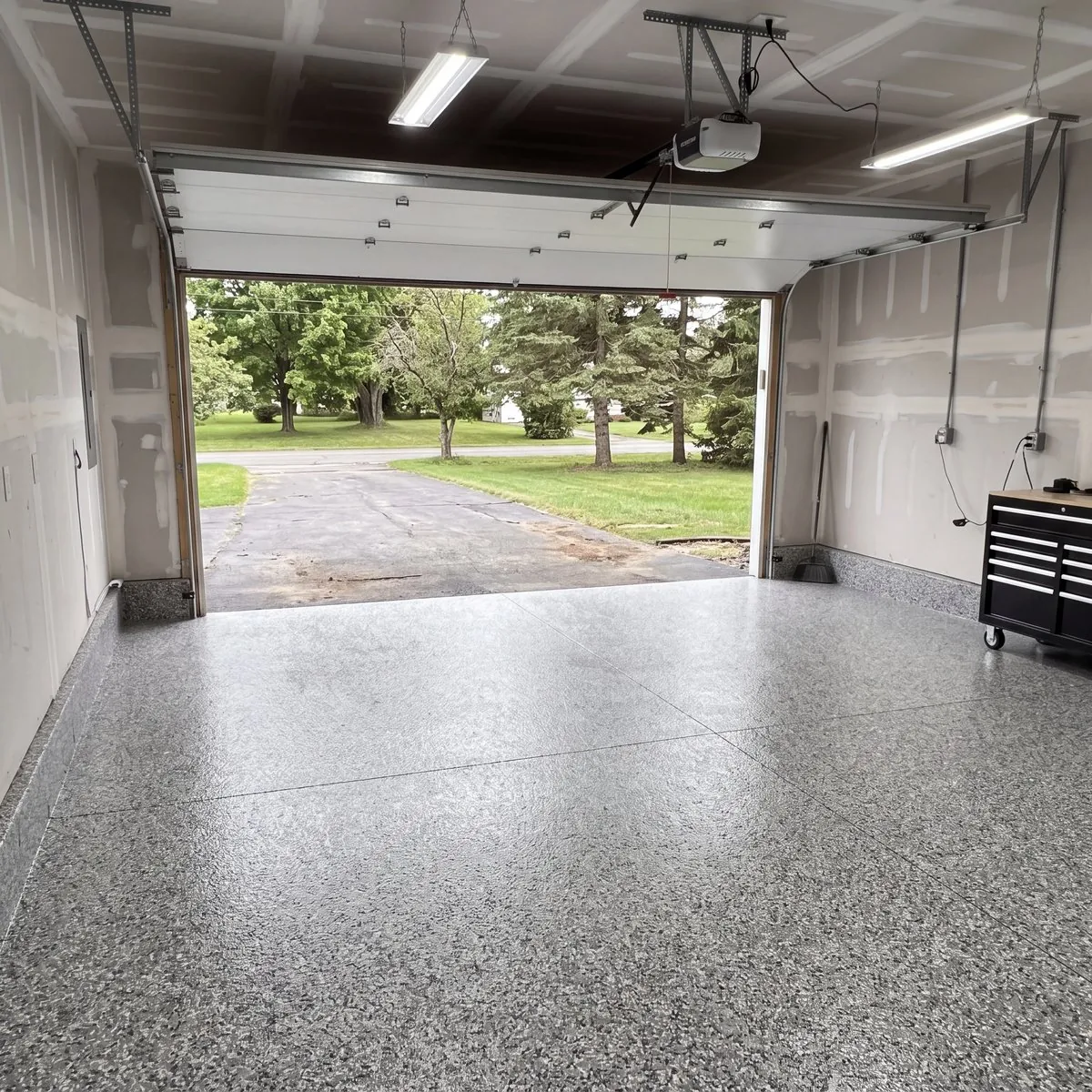

A full installation takes our crew 1.5 to 3 days on site depending on slab repairs and moisture prep. Once the final clearcoat goes down, the floor is walkable in 12 hours, ready for light foot traffic and storage items in 24 hours, and cured for daily vehicle parking after 72 hours. Every floor our owner-operated local crew based in Utica installs across Oneida, Jefferson, Oswego, Herkimer, and Lewis counties is backed in writing by our 1-year craftsmanship warranty against peeling, bond failure, and hot-tire pickup.
Polyaspartic Floor Coatings in Utica & Central NY
Around Utica, Rome, Watertown, Oswego, Herkimer and Lowville, we use polyaspartic as the clear topcoat, not as the whole system. A heavy diamond grind opens the concrete, a 100% solids epoxy basecoat soaks in and builds thickness, flake goes down over it, and the polyaspartic clearcoat finishes the floor.
That topcoat earns its spot on local floors. It resists sunlight yellowing, wipes clean of gasoline and motor oil, and stands up to hot tires when a car pulls into the garage from the road. It is the same clear coat we put over garage floors and over flake walkways and patios.
If you are weighing a one-day polyurea quote against our multi-day schedule, ask what is under the clearcoat and how the slab was prepped. We are glad to walk through it when we measure your floor, and you can see how we price each system on our epoxy floor cost page.
Why do some companies finish in one day?
A fast-cure polyurea basecoat lets a crew grind, coat, flake, and leave the same day. That speed is real, and so is the trade-off: the shorter the working time in the bucket, the less chance the basecoat has to soak deep into dense concrete before it gels.
Fast-Cure Surface Skin vs. Deep Concrete Pore Lock
Why working time in the bucket determines how deeply your basecoat anchors into diamond-ground concrete pores.
Our 1.5 to 3 days on site goes into heavy mechanical diamond grinding, crack repair, digital moisture testing, and letting the 100% solids epoxy basecoat cure overnight into the concrete pores before we scrape the flake and roll on the polyaspartic topcoat. If a faster return to service matters most on your project, polyaspartic is the material we would point you to rather than raw polyurea. Our full slab prep workflow is detailed on our about page, and if you are holding a regional one-day quote in Central New York, see our side-by-side Apollo Concrete Coatings vs. local Utica crew comparison.
Common questions about epoxy, polyurea and polyaspartic
- Is polyaspartic the same as epoxy? No. Polyaspartic is a modified polyurea, and epoxy is a different resin altogether. They are not rivals in our system: we use thick 100% solids epoxy as the basecoat that bonds to the concrete and polyaspartic as the clearcoat on top.
- Is polyurea stronger than epoxy? It depends on which epoxy you are comparing it to. The claims you see online usually line polyurea up against a thin, water-based roll-on kit from a hardware store. A 100% solids commercial epoxy is a different material: it goes on thick, has a long working time, and soaks into ground concrete before it hardens. The layer that decides whether a floor lasts is the one bonded to the slab, and that is where a thick basecoat with a long working time has the edge.
- Why do some companies finish a garage floor in one day? A fast-cure polyurea basecoat lets a crew coat a floor and leave the same day. The trade-off is working time and soak-in: polyurea can cure before it has worked into the concrete. Our garage floors take 1.5 to 3 days. The extra time goes into heavy diamond grinding, crack repair, a moisture check and letting the epoxy basecoat set up properly, not into waiting around.
- Which coating is right for a basement floor? For a basement, the question is moisture before it is chemistry. Basement slabs pass ground moisture up through the concrete, so we meter the slab and put a deep-sealing moisture-blocking basecoat under the epoxy where the reading calls for it. On top, a smooth polyaspartic or satin finish keeps the floor seamless, stain-resistant and easy to mop.
- What does an epoxy and polyaspartic floor cost per square foot? Most floors we install across Central and Northern New York fall between $7 and $17 per square foot, depending on square footage, slab condition, moisture-barrier needs, and whether you choose solid commercial epoxy, a full vinyl flake broadcast under polyaspartic clearcoat, or a 3D metallic pour. You get a clear written price whether our crew measures your slab in person or reviews your floor measurements and photos.
Holding a One-Day Polyurea Quote, or Pricing Your Floor From Scratch?
Share a few details about your space online, text photos of your concrete directly to our Utica crew at (315) 367-2711, or schedule an on-site visit. You get a clear written estimate so you can see what we would install and compare it side by side.