
Old Tile Glue Off, Dust-Free
Inside a Central New York basement: the grinder chewing through black tile adhesive and old paint down to clean concrete, with the vacuum catching the dust at the head.

WARM, DRY & DUST-FREE LOWER LEVELS. Bare basement concrete traps dampness and chalks dust. Based in Utica, our crew grinds your slab clean with HEPA-filtered diamond tooling, rolls on a moisture-blocking primer, and pours seamless flake or 3D metallic floors across Central NY—typically $7 to $17 per sq ft.

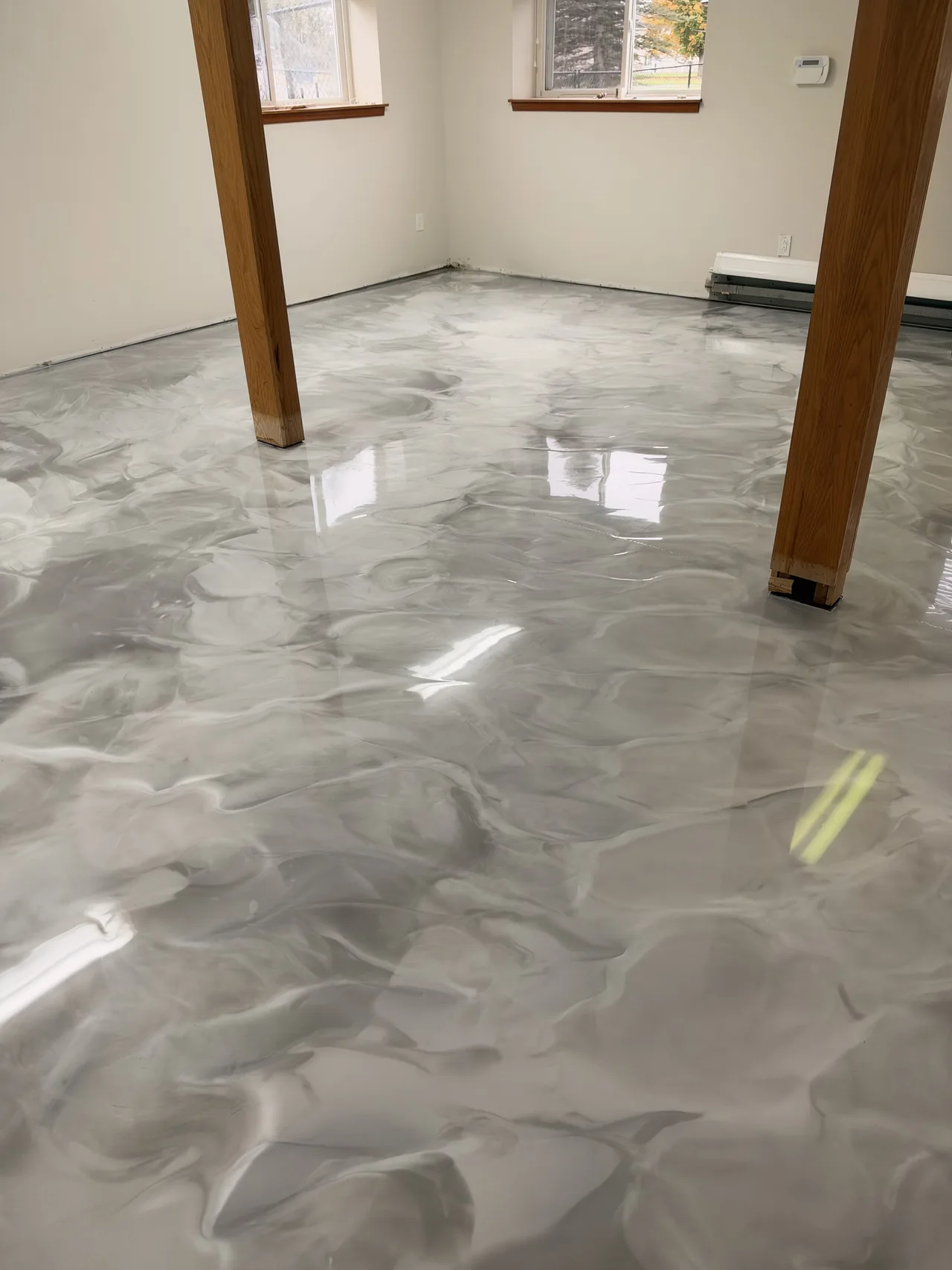

A basement slab is the dampest concrete in the house, and it shows: chalky dust on the stairs, a musty smell in the carpet, paint that bubbled off in sheets. An epoxy basement floor from our crew starts with a moisture reading, then grinds the slab clean and seals it under a finish that wipes up with a mop. Three of ours below.
Pearl, dove-gray and white metallic pigments poured over a moisture-tested slab and detailed cleanly around the wood support columns.
Bright white and mist-gray flake over a moisture-tested slab, cut in tight around the furnace pad and water heater so the room stays bright and sweepable.

Deep cobalt and silver swirled into one-of-a-kind marble veining under a glass-smooth clearcoat, the kind of floor a basement bar gets built around.
Basements add two problems a garage does not have: everything comes down a staircase, and the dust goes up it. Here is the order we work in, with video from a real Central New York basement.
Before anything else, we meter the slab in several spots. The reading decides whether the floor gets the standard basecoat or a moisture-blocking primer under it, and it tells us if the water problem is bigger than a coating can fix.
Walk-behind diamond grinders strip old tile glue, paint and the smooth top glaze. Every grinder runs on a HEPA vacuum, the stairwell is sealed off, and the rest of the house stays clean.
Cracks are chased and filled flush. Then a thick 100% solid epoxy basecoat seals the concrete, with the moisture-blocking primer rolled on first wherever the reading called for it.
A full flake broadcast or a hand-poured metallic goes over the basecoat, then a clearcoat locks it in. The result is one seamless surface with no grout lines, seams or edges for dampness to find.
Inside a Central New York basement: the grinder chewing through black tile adhesive and old paint down to clean concrete, with the vacuum catching the dust at the head.

What a sealed slab looks like before the finish goes on: cracks filled flush and the moisture-blocking basecoat laid down like glass. Every basement that reads damp gets this step.
Light blends like Juneau, Siberian, Husky and Mercury brighten a low-ceiling basement and hide dust between sweepings, broadcast at roughly 18 pounds of chips per 100 square feet so no bare basecoat shows through. For a finished family room or bar, a hand-poured metallic is the other option. Browse the blends below, and we bring real sample chips to your basement so you can see them on your own floor.


Every residential and commercial floor installed by our local crew includes a 1-year craftsmanship warranty covering installation and workmanship. Commercial coating materials are backed by the manufacturer's product warranty against bond failure, peeling, and delamination.
Direct mechanical diamond preparation, crack restoration, and moisture-tested application completed by our in-house Central New York installation crew with zero outsourced subcontractors.
100% solid commercial epoxy basecoats and UV-stable polyaspartic clearcoats backed by the manufacturer's product warranty against bond failure, peeling, and hot-tire delamination.
Pick the room, how the concrete looks today, and your rough floor size. Our local crew will reach out within 2 hours to talk it through, review photos, or schedule an in-home visit to check your slab moisture and show you samples.
Most basement floor epoxy we install goes into one of four rooms. Each gets the same moisture reading and prep, with a finish picked for how the room is used.
The room you are about to put a couch and a TV in. A metallic or a light flake floor reads as a finished floor, not a basement, and it is done before the drywall dust would have ruined carpet.
Washer overflow, water heater drips and softener brine all land on this floor. A bright flake floor wipes dry, shows nothing, and is cut in tight around the furnace pad and floor drain.
Rubber mats and desk chairs over bare concrete grind dust into everything. A sealed floor stays clean, takes a dropped dumbbell, and holds a mat without the chalk underneath.
You are not finishing it, you just want the boxes dry and the dust gone. A flake floor over a moisture-blocking basecoat does that, and leaves the room ready to finish later.
Groundwater pushes up through a basement slab as vapor all year, even when the floor looks dry. A basement floor coating put over that pressure blisters and lifts, which is why so many painted basement floors peel in sheets. The meter tells us how much pressure the slab carries before we commit to anything.
A low reading means the standard basecoat. A high reading means a moisture-blocking primer goes down first, and the floor is built on top of it. A slab that is actively wet, or water that comes in through the walls or the floor-wall joint, is a waterproofing job, not a coating job, and we will tell you that on the spot rather than coat over it.
Whether the slab needs the moisture-blocking primer, where the wettest spots are so they get extra attention, and whether white powder on the floor is mineral left by evaporating water or something else.
Water coming through the walls, up through a floor crack under pressure, or in at the floor-wall joint. Those need a drain, a sump or a wall repair first. We would rather lose the job than coat over a leak.
Every basement floor we replace was one of three things: paint that bubbled, carpet that smelled, or plank that curled at the seams. All three sit on top of a damp slab and lose to it eventually. A seamless basement floor coating is bonded into the ground-open concrete with the moisture handled underneath, so there is nothing for the dampness to get behind.
It is also the easiest basement floor to live with. No grout lines, no seams, no pad to hold water. A spill, a wet dog or a washer overflow gets mopped, and the floor is dry in an hour.
Thin and water-based, with nothing under it to stop vapor. Blisters over damp spots, peels in sheets, and has to be ground off before a real floor can go down.
Carpet pad holds every bit of dampness and gives it a smell. Plank floats on the slab and curls or gaps at the seams when the humidity swings. Both hide the problem until it is a bigger one.
Flake is the practical basement floor. Light blends like Juneau, Siberian, Husky and Mercury brighten a low-ceiling room, the speckle hides dust between sweepings, and the light texture gives grip at the bottom of the stairs. It is what we put in laundry rooms, gyms and storage.
Metallic is the showpiece floor. Pearlescent pigments hand-poured and moved into one-of-a-kind marble veining under a glass-smooth clearcoat, for the family room, the home bar or the theater. It shows dust and fine scratches a little more than flake, and no two pours match, which is the point. Either one goes over the same moisture-tested prep.
We seal out rising slab dampness, anchor slow-soaking 100% solids epoxy into ground concrete, and finish with stain-resistant polyaspartic that mops clean. Polyurea stays strictly in routed cracks.
"One-day" franchises roll fast-setting polyurea onto bare slabs instead. See what a 15-minute cure versus a 45-minute soak leaves inside concrete pores in our side-by-side breakdown.
Straight answers to what Central New York homeowners ask before they coat a basement.
From our Utica home base, our crew installs epoxy basement floors across Central New York. Pick your area to start a basement estimate with your town already filled in.
Epoxy basement floors for older homes across Utica, Rome, New Hartford, Whitesboro, Clinton, and Oneida County, where damp slabs and old glue are common.
Get a Utica Basement EstimateMoisture-tested basement and laundry room floors across Carthage, Sackets Harbor, and the Fort Drum area.
Get a Watertown Basement EstimateDry, sealed basement floors across Fulton, Pulaski, and nearby lakeshore towns where groundwater keeps slabs damp.
Get an Oswego Basement EstimateBasement floor coatings through Ilion, Frankfort, Little Falls, and year-round homes up in Old Forge.
Get a Herkimer Basement EstimateBasement and lower-level floors across Croghan, Lyons Falls, and surrounding towns.
Get a Lowville Basement EstimateAnswer a few questions below and your request goes straight to our Utica crew—no call centers or lead brokers. We reach out within 2 hours to share a written price range, look over photos, or schedule an on-site visit with real flake samples.